One of the greatest advantages of a temporary industrial hall as extra storage space or as a workspace is the ability to fully tailor it to your specific needs. One of those options is insulation. In this blog post, we will tell you more about the differences between insulated and non-insulated industrial halls and help you make the right choice.
Why Do You Need Insulation?
Do you need to store goods that require a constant temperature or humidity? Then insulation is essential. Insulated spaces help regulate temperature and humidity, which is crucial for products such as materials, food, or medicines that are sensitive to temperature fluctuations. Additionally, insulation makes the space more comfortable to work in, for example as a workshop or office space. Even in winter, you can continue working here without any problems.
Is Insulation Always Necessary?
Not necessarily. Whether you need insulation depends on what you are storing in the hall. If your goods are not sensitive to temperature changes and do not require a constant temperature, a non-insulated hall may be sufficient. Consider construction materials, non-perishable goods, or certain production processes. A non-insulated hall is an efficient, cost-saving option for these applications.
Advantages of an Insulated Temporary Hall
- Good temperature control: Thanks to the insulation materials, the temperature remains constant. This prevents damage to sensitive products and saves on energy costs.
- Protection against moisture: An insulated hall keeps moisture out, preventing damage from mold or corrosion.
- Comfortable workspaces: Because the temperature is easy to regulate, it ensures a pleasant working temperature, which promotes productivity.
Advantages of a Non-Insulated Temporary Hall
- Ideal for non-temperature-sensitive goods: Many construction materials, raw materials, or other non-perishable goods can be stored perfectly well in a non-insulated hall.
- Fast installation: Non-insulated tent halls are simple and quick to install – perfect if you need extra space quickly.
- More cost-efficient: In most cases, a non-insulated tent hall is cheaper than a partially or fully insulated tent hall. This is mainly due to the materials used.
Different Options for Insulation
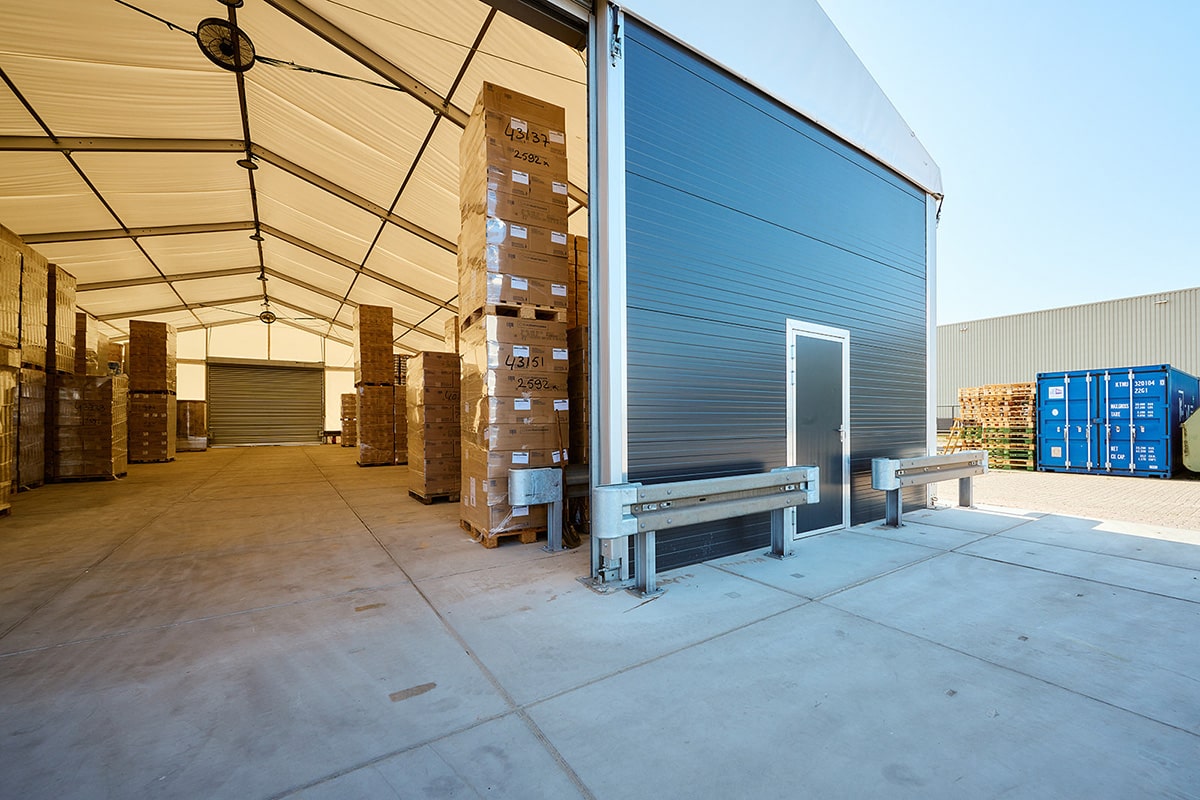
At Donselaar, we offer various temporary industrial halls, each with a different degree of insulation. The non-insulated hall is ideal for goods that are not sensitive to temperature changes and offers a simple, cost-effective solution. For extra protection against temperature, we have partially insulated industrial halls with side walls made of sandwich panels. For maximum temperature and humidity control, we offer fully insulated halls, equipped with double roof tarpaulins and a compressor that blows air between the tarpaulins, providing excellent roof insulation. This is perfect for sensitive goods or extreme weather conditions.
Which Hall Suits You?
Choosing between an insulated or non-insulated hall depends entirely on your specific situation. Our team is ready to advise you and determine together which solution best aligns with your wishes. Curious about the possibilities? Please contact us or request a quote directly. We are happy to help you further!